If you are searching for resort website development cost in India, you will quickly find that there is no single fixed price.
One developer may quote ₹10,000. Another may quote ₹30,000. A web agency may quote ₹75,000 or more. A custom booking platform with multiple integrations can cost considerably higher.
The reason is simple: a resort website is not always the same type of website.
A small villa that only needs photos, amenities, location and WhatsApp enquiries does not require the same development work as a large resort that needs room availability, online payments, booking management, automated confirmations and integrations.
So instead of asking only:
“How much does a resort website cost?”
you should ask:
“What exactly am I getting for the price?”
This guide explains the typical cost factors, website features, booking options, ongoing expenses and the current resort website packages available from ITheit.
Quick Answer: How Much Does a Resort Website Cost in India?
For a small or growing resort, villa, homestay or stay property, the website cost depends mainly on the number of pages, design requirements, booking functionality, payment integration, SEO work and third-party systems involved.
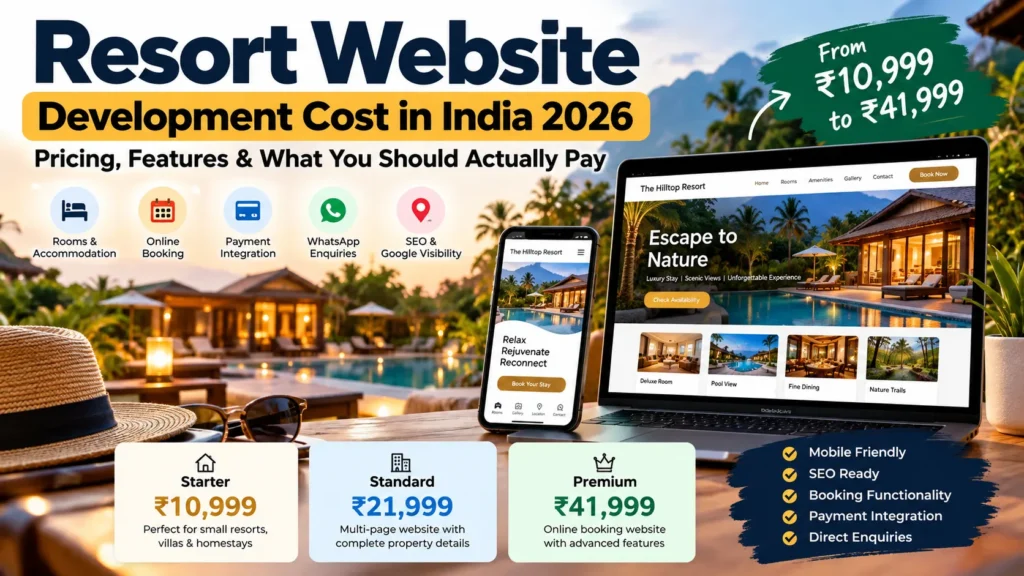
At ITheit, the current Villa, Resort & Stay Website product is listed in a range of ₹10,999 to ₹41,999, with different packages for different requirements.
| Website Type | Typical Requirement | ITheit Package |
|---|---|---|
| Starter | Single-page resort/villa website with enquiries | ₹10,999 |
| Standard | Multi-page website with stronger content structure | ₹21,999 |
| Premium | Booking-focused website with additional functionality | ₹41,999 |
The final scope should always be confirmed before development because additional functionality, third-party services and custom integrations can affect the total price.
What Determines Resort Website Development Cost?
There is no meaningful way to compare two website quotes without comparing their scope.
A ₹12,000 website and a ₹1,20,000 website can both be legitimate quotes if they are solving completely different problems.
Here are the main factors that affect resort website development cost in India.
1. Number of Pages
A simple property website may need only one long page containing:
- Resort introduction
- Rooms
- Amenities
- Gallery
- Location
- Contact details
- WhatsApp enquiry
A larger resort may need separate pages for:
- Home
- About
- Rooms
- Individual room types
- Amenities
- Gallery
- Dining
- Events
- Packages
- Nearby attractions
- Blog
- Contact
More pages generally mean more design, content formatting, testing and development work.
2. Website Design
A resort website depends heavily on presentation.
People want to see the property before they enquire. That makes photography, typography, layout, mobile design and navigation particularly important.
A basic website may use a simple template structure.
A more customized website may include:
- Custom homepage sections
- Room cards
- Image galleries
- Interactive sections
- Testimonials
- Offer sections
- Location information
- Mobile-specific design adjustments
- Strong enquiry buttons
The more custom the design, the more development time is generally required.
3. Booking Functionality
This is one of the biggest factors affecting resort website development cost.
There is a major difference between:
“Contact us on WhatsApp to check availability”
and:
“Choose dates → select room → check availability → pay online → receive confirmation.”
A simple enquiry website can be relatively inexpensive.
A website with a real booking workflow may require:
- Date selection
- Room selection
- Availability management
- Pricing rules
- Guest information
- Booking records
- Payment gateway
- Confirmation emails
- WhatsApp notifications
- Admin management
The development complexity rises as more of these functions are introduced.
Resort Website Packages by ITheit
ITheit currently offers villa, resort, homestay and stay-property websites in three broad package levels.
Starter Resort Website — ₹10,999
This package is intended for smaller properties that primarily need a professional online presence and direct enquiries.
Suitable for:
- Small resorts
- Villas
- Homestays
- Farm stays
- Weekend properties
- New hospitality businesses
Typical features include:
- Professional single-page website
- Resort introduction
- Rooms or accommodation section
- Amenities
- Photo gallery
- Contact information
- WhatsApp enquiry option
- Google Maps/location integration
- Mobile-responsive layout
- SEO-ready website structure
- Basic contact/enquiry functionality
The exact scope should be confirmed before development based on the property and required sections.
Best suited for
A property that does not need a complex online booking engine and is comfortable receiving enquiries through WhatsApp, phone or contact forms.
Standard Multi-Page Resort Website — ₹21,999
The Standard package is designed for a property that needs more information organised across multiple pages.
Instead of putting everything on a single page, important information can have its own sections or pages.
Typical structure:
- Home
- About the property
- Rooms & accommodation
- Amenities
- Gallery
- Nearby attractions
- Contact
- Enquiry section
Depending on the agreed scope, the website can also include additional sections for packages, activities, dining, events or other property information.
Why a multi-page structure can be useful
It gives potential guests more information before they contact you.
For example, someone searching for a family resort may want to see:
- Room options
- Swimming pool
- Food/dining
- Parking
- Activities
- Property location
- Nearby attractions
- Contact options
A properly structured website also gives you more useful pages to optimise around relevant searches.
For example:
“resort near Lonavala”
is a different search intent from:
“resort rooms in Lonavala”
or:
“family resort near Lonavala with swimming pool.”
You should not create hundreds of thin pages simply to target keywords, but useful pages that genuinely answer different customer needs can make the website more valuable.
Premium Resort Website — ₹41,999
The Premium package is intended for properties that require a more advanced booking-focused website.
The current ITheit product positions this package around booking functionality and SEO optimisation.
Depending on the agreed scope, this type of project may include features such as:
- Online booking workflow
- Date selection
- Room selection
- Availability functionality
- Booking enquiry forms
- Online payment integration
- Booking confirmation
- Booking management
- Location integration
- SEO-focused website structure
- Mobile optimisation
- More advanced property information
The exact features should be agreed in writing before development because booking systems can vary significantly in complexity.
Important
A basic booking plugin and a full hotel-management system are not the same thing.
A property requiring:
- Multiple room types
- Real-time availability
- OTA synchronisation
- Channel manager integration
- Dynamic pricing
- Multiple properties
- CRM integration
- GST workflows
- Advanced reporting
may require a more customised solution and additional third-party software or integration costs.
That is why you should never compare hospitality website prices only by looking at the headline number.
What Does a Resort Website Need?
Before choosing a package, think about what your potential guest needs to know.
A good resort website should answer the important questions quickly.
Property Information
Visitors should easily find:
- What type of property is this?
- Where is it located?
- Who is it suitable for?
- What rooms are available?
- What facilities are provided?
Rooms & Accommodation
Show:
- Room names
- Photos
- Room size where relevant
- Capacity
- Bed type
- Amenities
- Pricing information if you wish to publish it
- Booking/enquiry button
Good room information can reduce unnecessary questions and make it easier for visitors to decide whether the property suits them.
Photo Gallery
For hospitality businesses, images are extremely important.
Include photographs of:
- Rooms
- Pool
- Property exterior
- Garden
- Dining
- Activities
- Bathrooms
- Views
- Common areas
Do not fill the website with low-quality, badly cropped or duplicate images.
Professional-looking photography can make a significant difference to how guests perceive the property.
WhatsApp Booking vs Online Booking
Not every resort needs a complex booking engine on day one.
A small property may start with:
Website → WhatsApp enquiry → Owner confirms availability → Booking completed
That can be perfectly practical when the operation is small.
A larger property may prefer:
Website → Select dates → Select room → Payment → Confirmation
The second setup requires more development and ongoing management.
This is why the correct question is not:
“Should every resort have online booking?”
It is:
“How do we currently handle bookings, and what booking workflow would actually make the business easier to operate?”
What About Booking Platforms and OTAs?
Many resorts use platforms such as online travel agencies for discovery and bookings.
These platforms can provide reach, but they are not the same thing as owning your own website.
Your own website gives you control over:
- Branding
- Property information
- Photos
- Enquiries
- Content
- Website experience
- Direct communication
A website can work alongside booking platforms rather than trying to replace them completely.
For example:
Google Search → Property Website → WhatsApp Enquiry
can work alongside:
Booking Platform → Property Listing → Reservation
The right combination depends on how your property currently acquires bookings.
How Much Should You Budget Beyond the Website Development Cost?
The development fee is not always the complete cost of operating a website.
Ask the developer what is included and what renews later.
Possible ongoing expenses include:
Domain
Your domain needs to be renewed according to the registrar’s pricing.
A .in domain can be appropriate for an Indian property, while a .com may make sense for businesses targeting an international audience.
Hosting
Hosting is where the website files and database run.
A simple property website may have modest hosting requirements.
A high-traffic website or more resource-intensive booking system may require stronger hosting.
SSL
Your website should use HTTPS.
Maintenance
WordPress websites require ongoing maintenance such as:
- Plugin updates
- WordPress updates
- Security checks
- Backups
- Compatibility testing
- Content updates
SEO
Basic SEO setup is different from ongoing SEO.
Basic setup can include things such as:
- Page titles
- Meta descriptions
- Search-friendly URLs
- Image optimisation
- Sitemap
- Internal links
- Indexing setup
Ongoing SEO involves continued work such as:
- Keyword research
- Content creation
- Technical improvements
- Competitor analysis
- Search Console analysis
- Link acquisition
- Content updates
You should not assume that paying for website development automatically means the website will rank for competitive Google searches.
Is a ₹10,000 Resort Website Enough?
For some properties, yes.
For others, no.
It depends on what the business actually needs.
A small villa that receives bookings mainly through WhatsApp may not need a sophisticated booking engine.
It may need:
- A beautiful homepage
- Excellent photographs
- Room information
- Location
- Amenities
- Contact details
- Mobile-friendly design
Spending more money on features that the business will not use does not automatically make the website better.
The important thing is matching the website to the business model.
Is an Expensive Resort Website Always Better?
Not necessarily.
A higher quote can be justified when a project requires:
- Custom design
- Custom development
- Booking engine
- API integrations
- CRM
- Channel manager
- Multiple properties
- Advanced automation
- Dedicated infrastructure
- Custom dashboards
- Complex payment flows
At the same time, a small property may not need all of these features.
This is why scope matters more than the headline price.
A ₹40,000 website and a ₹2,00,000 website should not necessarily be compared as though they are competing for the same project.
The Most Important Questions to Ask Before Hiring a Resort Website Developer
Before paying an advance, ask for a written answer to these questions.
What exactly is included?
Get a clear list of:
- Number of pages
- Design scope
- Forms
- Maps
- Booking functionality
- Payment gateway
- SEO
- Hosting
- Domain
- Support
What is extra?
Ask specifically about:
- Premium plugins
- Paid booking software
- Payment gateway charges
- Third-party APIs
- Hosting upgrades
- Photography
- Copywriting
- Logo design
- Additional pages
- Future maintenance
Who owns the website?
Ideally, your business should have access to its own:
- Domain
- Hosting
- WordPress admin
- Website files
- Relevant accounts
Do not choose a provider based only on a cheap upfront quote while giving up control of your core digital assets.
Can I see previous work?
Ask for actual examples.
Do not judge a developer only from screenshots.
Live websites can tell you more about:
- Mobile experience
- Navigation
- Loading behaviour
- Design quality
- Content structure
- Forms
- Overall usability
How SEO Should Be Built Into a Resort Website
SEO should not be treated as simply putting the words “best resort” throughout the website.
A useful resort website should be structured around what potential guests actually search.
Examples may include:
- Resort near Mumbai
- Resort near [destination]
- Villa for weekend stay
- Family resort near [location]
- Resort with swimming pool in [location]
- Farm stay near [location]
- Weekend getaway near [destination]
- Resort rooms near [tourist attraction]
The exact keywords should depend on the property’s location, audience, facilities and competition.
Important SEO elements include:
Page Titles
Every important page should have a descriptive title related to the actual content.
Headings
Use a clear heading structure rather than repeating keywords unnaturally.
URLs
Keep URLs short, understandable and relevant.
Internal Links
Link related pages together so visitors and search engines can discover important content.
For example:
Home → Rooms → Booking → Contact
and:
Home → Location → Nearby Attractions → Contact
Image Optimisation
Resort websites often contain large images.
Compress images and use descriptive filenames and useful alt text.
Do not write alt text simply to insert keywords.
Mobile Experience
A large percentage of hospitality searches happen on mobile devices.
The website should work properly on smaller screens, with readable text, usable buttons and simple navigation.
Speed
Large photographs, unnecessary plugins and poorly optimised scripts can make hospitality websites slow.
Speed should therefore be considered during development rather than treated as a last-minute fix.
Can a New Resort Website Rank on Google Immediately?
There is no honest developer who can guarantee that a new website will reach a specific Google ranking within a specific number of days.
Google rankings depend on many factors, including:
- Search competition
- Website quality
- Content
- Relevance
- Location
- Authority
- Links
- Search intent
- Business profile signals
- User experience
- How established the property is online
A new resort should think about SEO as an ongoing process rather than a one-time website feature.
The website provides the foundation.
Search visibility develops over time through the combined effect of the website, useful content, the business’s online presence and promotion.
How to Build a Resort Website That Generates Direct Enquiries
The website does not need to be complicated to be useful.
Start with the journey you want the visitor to take.
Step 1: Visitor discovers your property
This may happen through:
- Google Search
- Google Maps
- Referral
- Booking platforms
Step 2: Visitor lands on your website
The first screen should quickly communicate:
- Property name
- Location
- Type of stay
- Main attraction
- Strong image
- Booking/enquiry action
Step 3: Visitor checks important information
They should quickly find:
- Rooms
- Amenities
- Photos
- Location
- Policies
- Contact details
Step 4: Visitor takes action
Give them a clear next step:
Check Availability
WhatsApp Us
Book Your Stay
Send Enquiry
Do not make the visitor search through five pages to find your phone number.
Common Mistakes Resort Owners Make
Mistake 1: Choosing Only by Price
The cheapest quote is not automatically the cheapest project in the long term.
Compare scope, ownership, support and ongoing costs.
Mistake 2: Using Too Many Heavy Images
Beautiful photography is important, but unoptimised images can slow down the website.
Compress and resize images before uploading them.
Mistake 3: Ignoring Mobile Users
A website that looks good on a desktop but is difficult to use on a phone can lose enquiries.
Always test the actual mobile experience.
Mistake 4: Treating the Website as a Complete Marketing Strategy
A website is an important digital asset, but it does not automatically generate traffic.
Promote the website through relevant channels and connect it with your broader online presence.
Mistake 5: Building a Booking System You Do Not Need
A small property may not need complex automation on day one.
Start with the booking workflow that matches your operation and expand later when the requirements justify it.
What Should a Resort Website Cost: A Practical Way to Think About It
Instead of deciding on a budget first and forcing everything into it, divide your requirements into three categories.
Level 1: Online Presence
You need:
- Professional design
- Property information
- Photos
- Amenities
- Location
- Contact form
This is suitable for smaller properties.
Level 2: Lead Generation
You need everything above plus:
- Multiple pages
- Better content structure
- Individual room information
- Strong calls to action
- Local SEO foundation
- Better enquiry flow
This works well for properties actively trying to generate direct enquiries.
Level 3: Online Booking
You need:
- Availability
- Date selection
- Booking workflow
- Payments
- Booking management
- Confirmation systems
- Potential third-party integrations
This requires more planning and development.
The key is to pay for the level of functionality your business actually needs.
Why ITheit’s Resort Website Offering Is Different
ITheit builds websites for businesses that want a practical online presence rather than unnecessary technical complexity.
For villa, resort and stay properties, the focus is on:
- Professional presentation
- Mobile-friendly design
- Direct enquiry options
- WhatsApp integration
- Property information
- Location integration
- Search-friendly structure
- Scalable functionality
The current ITheit resort product is available for properties in India and international locations, with packages ranging from ₹10,999 to ₹41,999.
The goal is not to sell every resort the same website.
A small villa can start with a simpler website.
A larger property can choose a more advanced booking-oriented setup.
And additional functionality can be discussed when the property actually needs it.
How ITheit Builds a Resort Website
The process starts with understanding the property rather than immediately installing a template.
Step 1: Requirement Discussion
We discuss:
- Property type
- Location
- Rooms
- Amenities
- Target guests
- Current booking process
- Website goals
- Required functionality
Step 2: Scope & Pricing
You receive a clear understanding of:
- What is included
- What is optional
- Expected delivery timeline
- Required content
- Future costs
Step 3: Content Collection
You provide the material required for the website, such as:
- Property photographs
- Logo
- Room information
- Amenities
- Contact details
- Location
- Social links
- Booking information
Step 4: Design & Development
The website is built according to the agreed scope.
Important areas such as mobile layout, forms, navigation and images are reviewed during development.
Step 5: Testing
Before launch, the website should be tested for:
- Mobile responsiveness
- Forms
- Links
- Navigation
- HTTPS
- Images
- Basic SEO configuration
- Booking workflow where applicable
Step 6: Launch
The domain, hosting and website are connected and the website goes live.
The current ITheit product page lists 5–7 working days for Starter and Standard and 7–14 working days for Premium, subject to the project’s content and scope.
What Information Should You Give Your Developer?
You can make the website development process much faster by preparing your information before development starts.
Keep these ready:
Property Details
- Resort name
- Full address
- Phone number
- WhatsApp number
- Google Maps location
Accommodation Details
- Room names
- Capacity
- Bed types
- Room amenities
- Price information
- Check-in/check-out policy
Property Amenities
For example:
- Swimming pool
- Restaurant
- Parking
- Wi-Fi
- Garden
- Indoor/outdoor activities
- Conference/event area
Only list facilities that your property actually provides.
Photos
Provide high-quality images of:
- Rooms
- Property
- Amenities
- Food
- Pool
- Surroundings
- Activities
Policies
Where applicable:
- Cancellation policy
- Check-in policy
- Pet policy
- Child policy
- Payment policy
- Refund policy
Clear information builds confidence before an enquiry.
Is a Resort Website Worth the Investment?
A website should not be evaluated only by asking whether it looks attractive.
Ask what business job it performs.
For example, a good website can help a property:
- Present itself professionally
- Explain rooms and amenities
- Build trust
- Make contact easier
- Receive WhatsApp enquiries
- Provide location information
- Support direct-booking efforts
- Build a long-term online presence
- Publish useful content for Google Search
But a website is not magic.
A newly launched website still needs visitors.
Promote the website through appropriate channels such as your Google Business Profile, social media, email, printed material and other relevant customer touchpoints.
A useful website becomes much more valuable when people can actually find and use it.
Frequently Asked Questions ?
The cost depends on the website scope and functionality. At ITheit, current villa, resort and stay website packages range from ₹10,999 to ₹41,999, with different package levels for simpler websites and more advanced booking-focused requirements.
A basic website can include property information, rooms, amenities, photos, contact details, WhatsApp enquiries, location information and a mobile-friendly SEO-ready structure.
The exact features depend on the package and agreed scope.
Very small properties may be able to start with a simple enquiry-focused website, but the exact current ITheit starting package is ₹10,999.
More pages and advanced booking functionality require a larger scope.
Not every package requires a full online booking system.
A simple website can collect WhatsApp or contact enquiries.
An advanced website can include booking functionality, depending on the selected package and agreed requirements.
Online payment can be integrated where required, but payment gateway setup and third-party services may involve separate requirements or charges depending on the solution used.
Your website and booking platforms serve different purposes.
Booking platforms can help with distribution and discovery, while your own website gives you greater control over your property’s branding, information and direct enquiry experience.
Many businesses use both.
No website developer can honestly guarantee a specific Google ranking simply because a website has been launched.
Your visibility depends on competition, relevance, content, technical SEO, online presence, authority and other factors.
A well-built website provides the foundation, but SEO usually requires ongoing work.
WordPress can be a practical option for many hospitality businesses because it supports content management, galleries, forms, SEO tools and booking-related functionality.
The right platform ultimately depends on your requirements, budget and the functionality you need.
Yes, a website can be planned so that additional functionality can be added later.
For example, a property can start with enquiry-based bookings and move toward a more advanced booking workflow as the business grows.
Website maintenance can be provided after launch for updates, security, content changes and technical support, depending on the maintenance arrangement.
Final Thoughts
There is no universal answer to resort website development cost in India.
A small villa website and a fully integrated resort booking platform are two very different projects.
For a small property, a simple professional website with strong photography, clear information, WhatsApp and enquiry functionality may be enough.
For a larger property, investing in a proper booking workflow may make more sense.
The important thing is to compare:
Price + Features + Ownership + Support + Ongoing Costs
rather than comparing the price alone.
At ITheit, current Villa, Resort & Stay website packages range from ₹10,999 to ₹41,999, so you can start with a simpler website and choose a more advanced option when your property’s requirements justify it.
Or discuss your requirements directly:
Email: [email protected]
Website: https://itheit.in/contact
ITheit Website & Ecommerce Development Company
Serving Mumbai, Vasai, Virar, Palghar, Kelwa, Boisar, Dahanu, Manor, Maharashtra, India & Worldwide.